The Next 50 Years of Manufacturing Starts Now
The inflection point is here. The evidence is at every major expo. The question is whether you'll lead from the front — or become the Blockbuster of your industry.
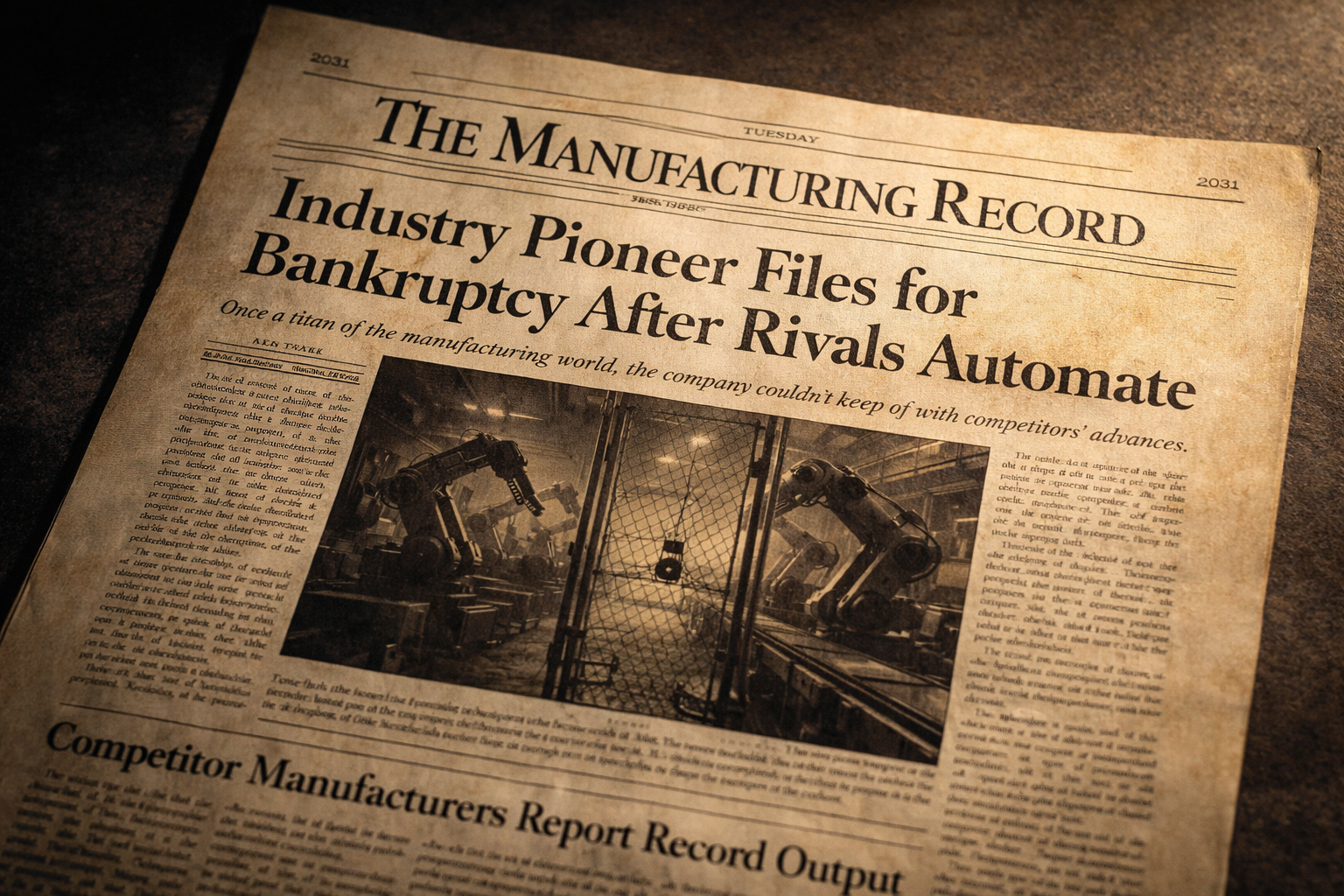
Every generation gets one moment where the underlying rules of an industry get rewritten.
Not improved. Rewritten.
Steam power didn’t make horse-drawn carriages faster. It made the question of horse-drawn carriages irrelevant.
The internet didn’t make the phone book more accurate. It made the question of a phone book irrelevant.
We are at that moment in manufacturing.
And most executives are still optimizing their horse-drawn carriages.
What Industry 4.0 Actually Was — and What It Missed
Before we talk about what’s next, we need to be precise about where we’ve been.
Industry 4.0 (the Fourth Industrial Revolution) gave manufacturing something genuinely valuable: connectivity, data, and digital intelligence layered on top of existing physical systems. IoT sensors. Digital twins. Machine-to-machine communication. Real-time operational visibility.
It was a meaningful evolution.
But it had a hard constraint.
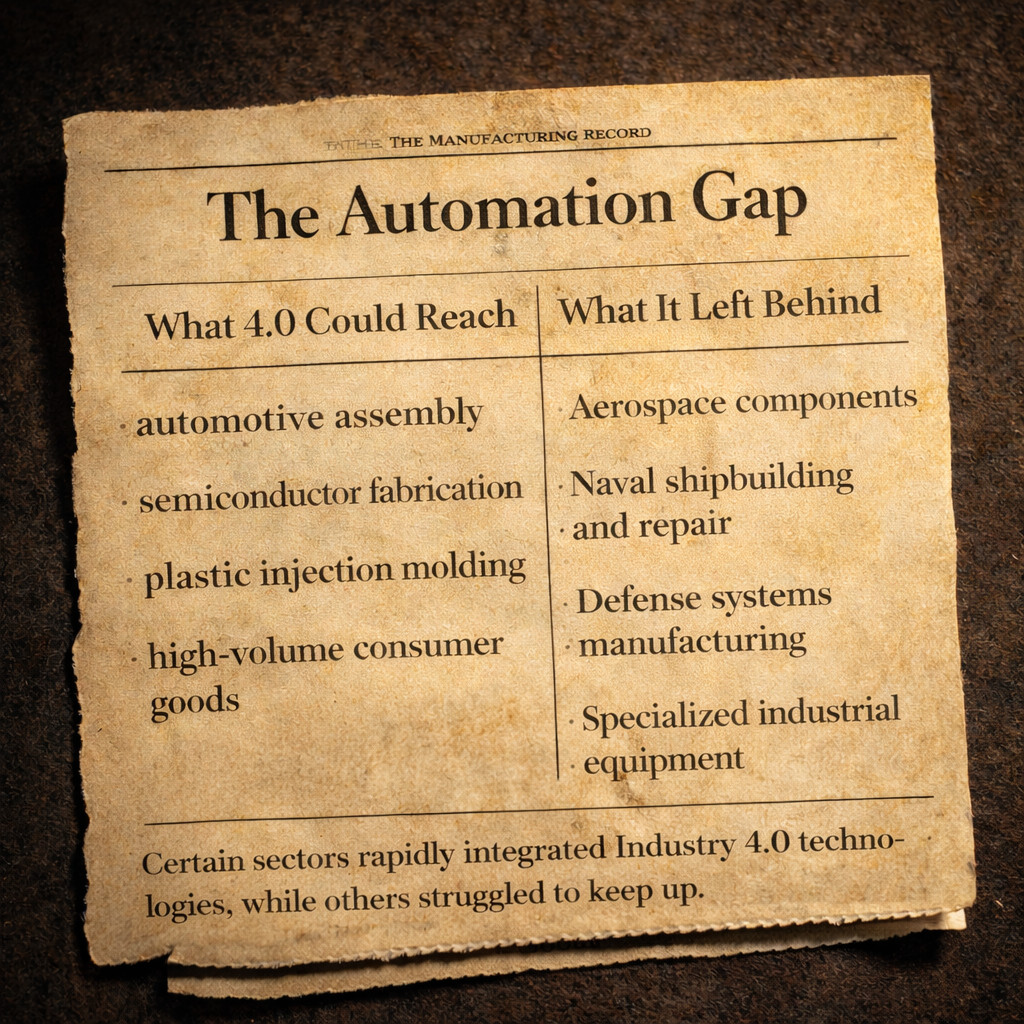
The robotics and automation it enabled were built for one type of work: high volume, low variation. Products consistent enough that a robot could be hard-coded by a programmer and execute the same motion thousands of times per day with virtually no deviation.
Think automotive assembly. Semiconductor fabrication. Plastic injection molding.
These are industries where the product barely changes. And when it does, it’s produced at such scale that it justifies fully reprogramming the system each time.
What that model left behind was enormous.
An entire tier of manufacturing operates in the opposite environment: higher mix, lower volume, more variation from part to part. Aerospace components. Custom metal fabrication. Surface treatment. Specialized industrial equipment.
This is the market where a robot shows up, can’t adapt to the slight variation in the part, and goes back in the crate.
If it doesn’t go back in the crate, it ends up in the corner of a warehouse, or in the middle of the floor, collecting dust. I’ve seen it firsthand. And I’m not talking about one robot. This could be an array of them.
Cobots. Industrial arms. Sitting idle. Not operational.
What drove that? It varies. Lost R&D budget because the POC required more than anyone scoped. A team that spent over a year trying to program it themselves and couldn’t get it to work. Whether it’s budget or programming complexity, one thing is clear: the old way of approaching this problem is not the solution.
I’ve heard some version of this from nearly every customer conversation I’ve had over the past year. They’ve been looking for an automation solution for years, sometimes a decade. The technology existed. It just couldn’t do their work.
That’s the gap Industry 4.0 left behind.
The Inflection Point
What’s changed in the past 18 months isn’t incremental.
The industry has been building toward this: robots that can adapt, adjust, and take on new work streams in real time. Actual adaptation, not a faster version of the same programmed loop.
Humanoid robotics gets the headlines. That’s a different conversation. What’s quietly redefining production floors today is something more practical, already deployed in real production environments.
What I’m describing is the orchestration layer, where AI at the software level interacts directly with the physical world. The industry has started calling this Physical AI, though in 2026 that term is being defined in a number of different ways depending on who you ask.
Here’s what it actually means in a production environment.
The first part is perception. Understanding the geometry of the actual part in front of the robot, without needing a CAD file to do it. CAD was always the starting point for traditional automation. The problem is that anyone who has spent time on a manufacturing floor knows the CAD file is not what’s actually being produced. There’s variance. Sometimes significant variance. The part in the fixture is not the part in the model, and a system that can only operate on the assumption that those two things match will fail the moment reality diverges from the drawing, which is constantly.
The second part is execution. Once the system understands what it’s working on, it needs to actually do the work at a quality and repeatability that meets production standards. That means production-grade precision, on real parts, in real conditions. A demo environment is not the bar.
Sensing the physical world as it actually is, then acting on it with that level of precision — that combination is what shifts the question for manufacturing from “Is this product consistent enough to automate?” to “What’s the right human-robot mix for this workflow?”
That’s a different question. And it opens the door to a much larger market.
The Evidence Is Already at the Shows
If you want to understand where manufacturing actually is right now, follow the expos.
Fabtech 2025, Chicago. The largest show floor in the event’s history. Over 42,000 manufacturing professionals. More than 1,700 exhibitors. The dominant narrative: AI as a tool to optimize what already exists. Smarter welding cells. Faster material handling. Better data visibility.
Real progress. Still squarely in the 4.0 playbook.
The focus was on taking 95% to 96% efficiency, squeezing more out of existing systems. The next generation of technology was present, but it wasn’t the headline. Most of the industry was looking in the rearview mirror and calling it forward motion.
CES 2026, Las Vegas. A very different room.
I was on the floor. And it was impossible to miss.
NVIDIA anchored the show at the Fontainebleau, and their footprint told the whole story before a single session started. Every direction you turned from that booth was a partnership: robotic manufacturers, robotics companies, automotive. The thread connecting all of it was the same: AI embedded into hardware, into physical systems, into things that move and act in the real world.
It didn’t stop there. Walk the main conference floor and nearly every exhibit was a hardware object being enhanced by some combination of AI and new sensing capability. Industrial equipment. Autonomous platforms. Vehicles. The physical world was getting a software layer, and it was clearly not a prototype stage. These were products. Shipping or near-shipping.
The outside commentary confirmed what was already obvious to anyone walking the floor. Scientific American called it “AI leaving the screen and entering the real world.” TechCrunch put it plainly: “CES 2026 was all about Physical AI and robots, robots, robots.”
AI in hardware wasn’t a vision at CES 2026. It was a product category.
ConExpo-Con/Agg 2026, Las Vegas. This is where the contrast becomes stark.
ConExpo is one of the largest trade shows of its kind on earth. Nearly 3 million square feet. Roughly 2,000 exhibitors. An event that happens once every three years. It’s where the people who build the physical infrastructure of America show up. Cranes. Heavy equipment. The machinery that shapes the foundation of the economy.
The major players who showcased Physical AI at CES were there, with the same technology, further refined for the audience in front of them.
The rest of the show? Traditional. Raw horsepower. Torque. Tensile strength. The same evaluation criteria that have defined this industry for the last 50 to 100 years.
By my count, fewer than 5% of exhibitors were engaging with any layer of Physical AI.
That gap between the 5% and the 95% is both the opportunity and the warning.
We’ve Seen This Movie Before
The iPhone parallel gets used a lot to describe moments like this one.
I’ve used it myself.
But it’s the wrong analogy.
The iPhone was a consumer platform shift. It created Uber, Instagram, DoorDash — behaviors and businesses built on a new medium. The disruption was in how people lived.
What’s happening in manufacturing is different. It’s an enterprise platform shift.
The closer parallel is the move from on-premise software to the cloud.
That transition looked optional for a long time. The technology was imperfect. The ROI wasn’t obvious on day one. And the companies that treated it as optional spent the next decade watching a gap widen that they couldn’t close by working harder.
Capital One began its cloud migration in 2012, when most banks were still protecting their mainframes. By November 2020, they had closed all eight of their on-premises data centers and migrated nearly 2,000 applications to AWS, completing an eight-year transition that most of their competitors still haven’t finished. Today they are the only major U.S. bank running 100% in the cloud. When a new fraud pattern emerges, they update and redeploy their detection models in hours. JPMorgan Chase and Bank of America measure the same process in days or weeks. JPMorgan spends $18 billion annually on technology. Fifty to sixty percent of that goes to maintaining legacy infrastructure. Capital One allocates 80% of its tech budget to building new capability.
That gap doesn’t close with effort. It closes with time. If it closes at all.
Caterpillar didn’t build their AI advantage during the AI era. They built it during the data era. Their Helios platform connects 1.5 million machines and assets worldwide and processes more than 50 billion data points per month across 16 petabytes of data. That infrastructure exists because someone made a decision years ago to invest in cloud-connected data systems before the returns were obvious. The AI moat their competitors are trying to replicate today isn’t an AI problem. It’s a data infrastructure problem, and it takes years to solve.
Lockheed Martin adopted digital twin technology and model-based engineering early, when the rest of the defense industrial base was still on legacy systems. They became the first non-government entity to independently operate inside Microsoft’s classified cloud. As Space Force demand surges and program timelines compress, the companies with that digital foundation already in place are the ones that can respond. The others are still building the foundation.

The pattern is the same in every case.
The companies that made the call before the answer was obvious are now positioned in ways their competitors cannot simply replicate by working harder or spending more.
Physical AI is that call for manufacturing. The platform is here. The early applications are in production. The foundation you build over the next two to five years is the one your competitors will be measuring against a decade from now.
Where Adoption Is Stalling
The technology is ready enough. The market need is real.
So why isn’t adoption moving faster?
Startups are moving. Risk-on by nature, fast at evaluation, willing to be early. They understand that getting an edge before the market consolidates is worth some uncertainty.
Enterprises are a different story.
Long procurement cycles. Multi-stakeholder reviews. Legal, security, and budget approvals. By the time it clears the gauntlet, the context that made it urgent is gone.
By the time the question reaches the C-suite, it’s been filtered through layers of operational concern. The framing becomes: “What’s the risk of doing this?”
That’s the wrong question.
The better question: what’s the cost of waiting?
Death by evaluation is real. I’ve watched strong companies spend 12 to 18 months evaluating a technology, reach no conclusion, and find themselves further behind than when they started.
The technology was good enough. The people running the evaluation didn’t have the strategic context to make the call.
This can’t be solved by better procurement processes. It has to start at the top.
The Expert Trap
Not long ago, I was in a conversation with a senior executive at one of the largest air transportation companies in the United States.
We were evaluating next-generation automation — what it could do, how to define success, what deployment would actually look like.
The executive was sharp and experienced. They had spent years building expertise in Industry 4.0. They had spoken at conferences on the topic. They came into that conversation with genuine authority.
And that authority was exactly what made the conversation difficult.
Every capability we discussed got filtered through the lens of what Industry 4.0 could already do. The evaluation criteria were anchored in a paradigm built for different constraints and different problems. The bar for success was shaped by a generation of technology that was never designed to solve what was sitting in front of them.
It wasn’t resistance for the sake of resistance. It was something subtler.
When you’ve been recognized as an expert in a paradigm, your credibility is tied to it. When something new arrives that operates on fundamentally different principles, the reflex is to evaluate it by standards you already know. It has nothing to do with intelligence. It’s just how expertise works. It’s efficient. Until it isn’t.
The textbook that made you an expert is an old edition.
Industry 4.0 expertise is genuinely valuable. It gives you context. It gives you a baseline. It tells you what the last chapter looked like. What it can’t do, on its own, is give you the right lens for the next one.
New technology sets a different bar, built for problems the previous generation wasn’t designed to solve. Evaluating Physical AI against Industry 4.0 standards is the same as evaluating a smartphone by how well it performs as a telephone.
Every major technology has a maturity curve. CNC machining. Robotics. ERP systems. Cloud infrastructure. The companies leading in those categories today weren’t the ones who waited until the technology was perfect. They were the ones who invested in learning while it was still becoming what it was going to be.
The question for an executive isn’t whether the technology is mature enough.
It’s which part of that curve you want your organization to be on — and what it costs you if a key competitor is three years ahead.
The Workforce Crisis Is the Forcing Function
What makes this cycle different from every previous technology inflection is that the workforce problem isn’t going to self-correct.
The manufacturing workforce is not going to recover on its own.
Deloitte and The Manufacturing Institute project 2.1 million unfilled manufacturing jobs by 2030. The cost of that gap: $1 trillion, in that year alone. As of mid-2025, 415,000 manufacturing roles were already sitting vacant. Roughly 20% of U.S. manufacturing plants were operating below full capacity, not because of weak demand, but because of labor.
I think about this personally.
My father spent his career as a mechanic — first at Trans World Airlines, later at BART, the Bay Area’s primary transit system. He was skilled. He was proud of his work. He also made clear, in every way a parent does, that he wanted something different for me. Cleaner conditions. Less physical risk. Less exposure to the dust and particulates that came home with him every day.
In the past six months, I’ve been on manufacturing floors that make his environment look pristine. Foundries. Shipyards. Places where the particulate levels are orders of magnitude higher — where full PPE isn’t a precaution, it’s the baseline requirement for getting through a shift.
My dad wanted me out of environments like his. I can only imagine what the parents working those floors are telling their kids.
That’s what every generation of skilled workers quietly hopes for their children. And it means the pipeline filling those roles gets narrower every decade.
The workforce isn’t here. In North America, importing it at scale is not a viable path. Wages are rising. Churn is high. For facilities outside of major metro areas, the addressable labor pool is simply too small to staff at the level the business needs.
For many manufacturers today, the single biggest risk to the business is no longer on the demand side.
It’s on the production side.
Automation in that environment isn’t a nice-to-have. It’s a survival strategy.
Two Types of Leaders
In every conversation I have with manufacturing leadership, I keep seeing two very different approaches.
The first group is reactive. A competitor already moved. The business is slipping. The urgency is real, but it’s fear-driven. They’re evaluating new technology through a risk-reduction lens, which slows the very decision they need to make quickly. As a service provider, that still leads to a sale. But it doesn’t lead to the outcome they’re actually after.
The second group is different. They understand that the only constant is change, in markets, in customers, in workforce availability, in technology. They’re not waiting for the perfect solution. They’re building the internal capability to learn and adapt before it becomes a crisis.
The companies that define the next chapter of manufacturing will come from that second group.
The Strategic Imperative
This is not an operations project.
The companies that figure out Physical AI won’t do it because a floor manager ran a pilot and escalated the results. They’ll do it because someone at the board level recognized that the question of how they compete over the next 10 to 50 years is on the table right now.
The innovator’s dilemma isn’t a theory. It’s a pattern. Well-run companies fail by optimizing for what made them successful while the disruption that rewrites the game moves past them. Kodak didn’t fail for lack of capability. Blockbuster didn’t fail for lack of effort. They failed because no one at the right level made the call to invest in what came next.
You don’t need a perfect thesis on day one.
You need a commitment to building one.
Start by asking:
- What portion of our work sits in the high-mix, variable category that traditional automation couldn’t reach?
- Where does the skilled labor shortage actually constrain our production capacity, today and in five years?
- What does it mean for our competitive position if a key competitor figures this out 18 months before we do?
This is already in motion. Across the Armed Forces. Defense contractors. Specialty vehicle manufacturers. Consumer goods companies. The largest and most future-forward manufacturers in the Americas are already making moves. Quietly, deliberately, with a clear eye on what the next decade of competition looks like.
The question isn’t whether Physical AI is ready to be taken seriously.
The question is whether you are.
The companies that define the next era of manufacturing aren’t waiting for the technology to be perfect.
They’re learning how to use it while it’s still becoming what it’s going to be.
That’s how you don’t become the Blockbuster of your industry.
Check out the original post on X or the LinkedIn version.
Keep Reading
If This Is Not On Your 2026 Roadmap, You Are Already Behind
2025 made one thing painfully clear for manufacturing leaders. This is no longer about experimenting with automation. It is about survival.
Future-Proof Your Factory With Robots
The factories that will thrive in the next decade are the ones investing in adaptive automation today. Here's what that actually looks like.
American Manufacturing As We Know It Is Collapsing
The manufacturing workforce is aging out faster than we can replace it. Automation isn't optional anymore — it's survival.

Working on a problem in manufacturing, AI, or scaling operations?
Let's connect →